Can You Install a Metal Roof in Winter in Ontario? A Contractor's Guide

Winter does not stop metal roof installation in Ontario - and in many cases, it does not even slow it down. Unlike asphalt shingles, which require above-freezing temperatures for the thermal sealing strip to activate, steel roofing systems are mechanically fastened and do not depend on ambient temperature to perform correctly from day one.
This guide covers what metal roof winter installation actually looks like in Ontario: the temperature ranges that govern sealant application, underlayment performance, and crew safety; how standing seam and metal tile systems behave in cold conditions; and how to decide whether your project is better booked for winter or spring.
Why Metal Roofing Performs Better Than Shingles in Cold-Weather Installation
The core reason metal roofing handles Ontario winters better than asphalt shingles is mechanical vs. adhesive fastening.
Asphalt shingles depend on a self-sealing adhesive strip along each tab. That strip requires sustained warmth (typically above 10 degrees Celsius) to bond properly. Install shingles below that threshold and the tabs may not seal until spring - which creates wind-uplift and water infiltration risk during exactly the season when those risks are highest.
Metal roof panels are fastened mechanically - either with concealed clips (standing seam) or through-fasteners with EPDM gaskets (exposed fastener profiles). The fastening system does not rely on temperature-dependent adhesion. Once the panel is set, clipped, and the next panel locks over the clip or fastener, the system is mechanically engaged and sealed regardless of whether the temperature is 20 degrees or -15 degrees.
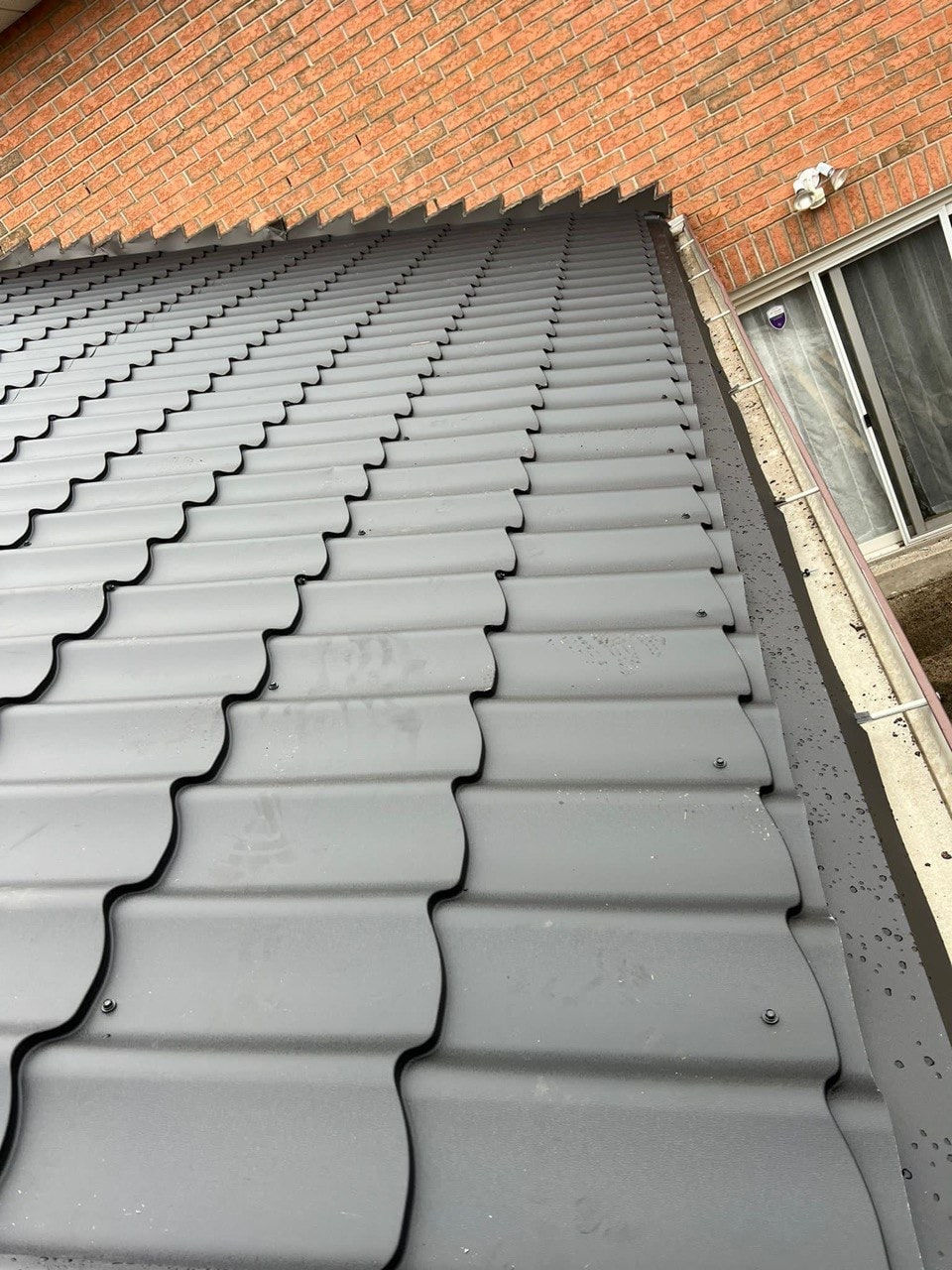
The result: a standing seam or Monterey metal tile system installed in January in Barrie is structurally complete and weathertight from the moment the ridge cap is installed - no waiting for spring to activate a seal.

Working Temperature Ranges for Screws, Sealants, and Underlayments
Mechanical fastening is temperature-tolerant. The materials used alongside the panel system have narrower windows, and a professional crew manages those windows carefully.
Sealants and butyl tape
Butyl tape and EPDM-based sealants used at penetrations, eaves, valleys, and ridge details have a recommended application window. Most major manufacturers specify a minimum application temperature of -18 to -10 degrees Celsius, with -10 to 0 degrees as the ideal cold-weather range. Below these thresholds, sealant viscosity increases, flow is reduced, and adhesion to cold metal and wood substrates becomes unreliable.
In practice, experienced crews warm sealant cartridges before application on cold-weather projects and work in short sequences - applying material before it cools on the deck. On days below -18 degrees Celsius, sealant-dependent details (particularly ridge penetrations and skylight perimeters) are typically deferred to a warmer window or performed in a controlled sequence with portable heat applied to the substrate.
Synthetic underlayments and ice-and-water shield
Modern synthetic underlayments remain flexible to approximately -30 degrees Celsius. Traditional felt underlayments become brittle below -7 degrees and can crack under foot traffic - one more reason Mroof specifies synthetic high-temperature underlayment on every project regardless of season. Ice-and-water shield at eaves and valleys requires a clean, dry substrate above approximately -10 degrees; Mroof crews bring substrate temperatures up locally when needed before membrane application.
Fasteners and clips
Steel fasteners and standing seam clips perform without any temperature limitation within Ontario winter ranges. Thermal expansion engineering is actually more straightforward in cold weather - the panel is at or near its contracted state at installation, and clip float is sized to accommodate summer expansion rather than winter contraction.
Panel Behaviour in Cold Conditions: Standing Seam vs. Exposed Fastener

Standing seam in cold weather
Standing seam systems are engineered specifically to accommodate thermal movement through floating clips. The panel is not rigidly fastened through its face - it rests in a clip that allows longitudinal movement as the panel expands and contracts. A 10-metre standing seam panel can move 10 to 12 millimetres across the annual thermal cycle from Ontario summer to Ontario winter.
Installing a standing seam system in winter means the panel is near its contracted state. Clips are positioned to allow room for summer expansion, and that calculation is part of the system design rather than an on-site improvisation. The result is a system that is dimensionally stable across the full seasonal range from day one.
Metal tile in cold weather
Monterey, Era, Modern, and Bond style metal tile profiles are lock-seamed panels. Each tile interlocks mechanically with the adjacent course - a temperature-independent action. Cold temperatures stiffen the panel slightly, making it easier to handle and position precisely. Experienced standing seam and metal tile crews often prefer working in cool to cold conditions for this reason: panels are dimensionally stable, alignment is predictable, and the risk of mid-course thermal growth is zero.
Snow, Ice, and Crew Safety on Ontario Winter Projects

Safety standards do not change in winter - they are applied with greater attention to conditions.
Mroof does not allow crews to access roofs with accumulated snow or ice on the deck surface. Prior to any winter installation day, the deck must be clear. On active projects, Mroof coordinates clearing schedules with the homeowner before crew arrival.
Ambient conditions that pause or stop work:
Active precipitation (snow, freezing rain, sleet) - work stops until precipitation ends and the deck surface is verified dry and safe.
Surface ice on the deck - work does not begin until ice is removed and the surface is confirmed safe for foot traffic with appropriate footwear.
Wind speeds above approximately 50 km/h - panel handling pauses. Large standing seam panels behave like sails in high wind and positioning becomes unsafe.
Temperature below -20 degrees Celsius (wind chill considered) - at the crew's safety judgment, work may be paused for warmup periods or deferred. Steel tools and equipment become brittle and risk of slips increases significantly.
These thresholds are standard across reputable Ontario contractors. A crew that does not pause for ice or high wind on a steep residential roof is operating outside accepted safety practice - that is a question worth asking when comparing quotes.
Emergency vs. Planned Replacement: A Decision Framework
The right answer on timing depends on why you are replacing the roof.
Emergency replacement (active leak, storm damage, failed existing roof)
If the existing roof is failing in winter - active leak, ice dam damage, or catastrophic storm damage - waiting until spring is not an option. In these cases, Mroof can mobilize an emergency assessment and, where weather conditions permit, begin installation. Metal roofing is one of the few roofing systems that can be installed year-round in Ontario by an experienced crew - that is a practical advantage in an emergency situation.
In an emergency, Mroof prioritizes making the structure weathertight. If a full installation is not possible on a given day due to conditions, a temporary protective layer is applied to stop water entry while the permanent system is staged.
Planned replacement (aging shingles, upcoming renovation, new construction)
If you are planning ahead, there is no single wrong season. Winter installation offers some advantages - contractor availability tends to be higher, scheduling lead times shorter, and material delivery from the Mississauga warehouse is consistent year-round.
Spring (March to May) is the highest-demand booking window in Ontario. If you want a spring installation, booking in December or January - with materials ordered early - is the recommended path. Most homeowners who contact Mroof in April for a May start are managing a longer queue than those who booked in winter.
Summer and fall installations are straightforward with no cold-weather considerations. The primary constraint in summer is scheduling volume - peak season fills quickly.
The practical guidance: if your roof is structurally sound and you have time, book whenever you are ready. Metal roofing does not have a "wrong season" for installation with a qualified crew. If you are comparing bids, the presence of a winter installation track record from a contractor is a useful quality indicator - it means their crew has done the work in conditions that require more careful material management and site safety discipline.
How Mroof Handles Winter Projects Across the GTA, Barrie, and Eastern Ontario
Mroof serves homeowners across the GTA and Southern Ontario year-round, including cold-weather markets in Barrie, Peterborough, Kingston, and communities north of the GTA where winter sets in earlier and harder than in Toronto and Mississauga.
Winter projects in these markets follow the same system specifications as any other season - synthetic underlayment, ice-and-water shield at eaves, valleys, and penetrations, concealed-fastener panels, and full warranty documentation. The only practical difference in a cold-weather project is scheduling: Mroof coordinates a weather-window assessment with the homeowner in advance and stages material delivery so that panels and underlayment are warmed before installation rather than pulled directly from a cold truck.
Homeowners in Barrie or Peterborough who need replacement work in November or February have the same access to a full Mroof installation as a homeowner in Oakville in May. If you are north of the GTA and need an assessment, call 1 416 857-7143 or request a quote online - Mroof will confirm whether your project is in the current service window and what scheduling looks like.
Key Takeaways
Metal roofing does not require above-freezing temperatures to install - the mechanical fastening system is temperature-independent.
Asphalt shingles require ambient warmth for the adhesive seal to activate; metal roofing does not share this constraint.
Sealants, underlayments, and ice-and-water shield have minimum application temperatures that an experienced crew manages through material handling and application sequencing.
Standing seam panels are dimensionally stable and easier to align precisely in cold conditions.
Safety thresholds for ice, precipitation, and wind apply regardless of season - a reputable contractor pauses for conditions.
For emergency replacements, metal roofing is one of the few systems a qualified crew can install year-round in Ontario.
For planned replacements, winter booking often means shorter lead times and better scheduling availability ahead of the spring demand peak.
FAQ: Metal Roof Installation in Winter in Ontario
Is winter metal roof installation more expensive than summer? Not as a rule. Mroof does not charge a season surcharge for winter installation. If a project requires additional material handling steps due to cold temperatures - warming sealants, staged delivery - that is part of the standard professional process, not a line-item. Get a written, itemized quote before signing; any reputable contractor will provide one.
Does cold-weather installation affect my warranty? No, provided the installation meets manufacturer specifications. Manufacturer certification and compliant installation method - not season of installation - determine warranty validity. Your Mroof workmanship warranty and the panel manufacturer finish warranty both apply to winter-completed projects.
Can Mroof install a metal roof with snow on the ground? Snow on the ground is not a barrier to installation. Snow or ice on the roof deck is a different issue - the deck must be clear and safe before crew access. Mroof coordinates deck clearance as part of winter project staging.
How long does a winter metal roof installation take compared to summer? Project duration is similar. A straightforward residential standing seam installation in winter typically takes 3 to 6 days depending on roof complexity, the same as in summer. Cold conditions add material handling steps but do not materially extend project timelines with an experienced crew.
Should I wait until spring if my shingles are failing? If your existing roof is actively leaking or at risk of failure, waiting is not advisable. Water entry in winter accelerates structural damage - sheathing, rafters, and insulation degrade faster when wet and cold than in other seasons. An emergency assessment from Mroof will confirm whether a full installation is feasible within current weather windows, and what temporary protection options exist if a full start must be staged.
Request a Professional Metal Roofing Quote for Your Ontario Home
Mroof is a metal roofing contractor serving Toronto, the GTA, and Southern Ontario year-round. We design, supply, and install premium metal roofing systems built on European-manufactured steel from Ruukki (Finland), ThyssenKrupp (Germany), and ArcelorMittal (Germany, Belgium), with a stacked material and workmanship warranty on every project.
Free on-site assessment. Written quote within 48 hours. No obligation.
Rated 5.0 across 100+ verified Google reviews. Free on-site assessments across the GTA.
About Mroof
Mroof is a premium metal roofing contractor serving Toronto, the GTA, and Southern Ontario. We design, supply, and install standing seam and metal tile systems engineered for Ontario's hail, wind, snow, and freeze-thaw conditions. Every project is delivered by manufacturer-certified installers and backed by a transferable workmanship warranty alongside 30 to 50 year finish warranties from the panel manufacturer. Free on-site assessments across the GTA. Call 1 416 857-7143 or request a quote.