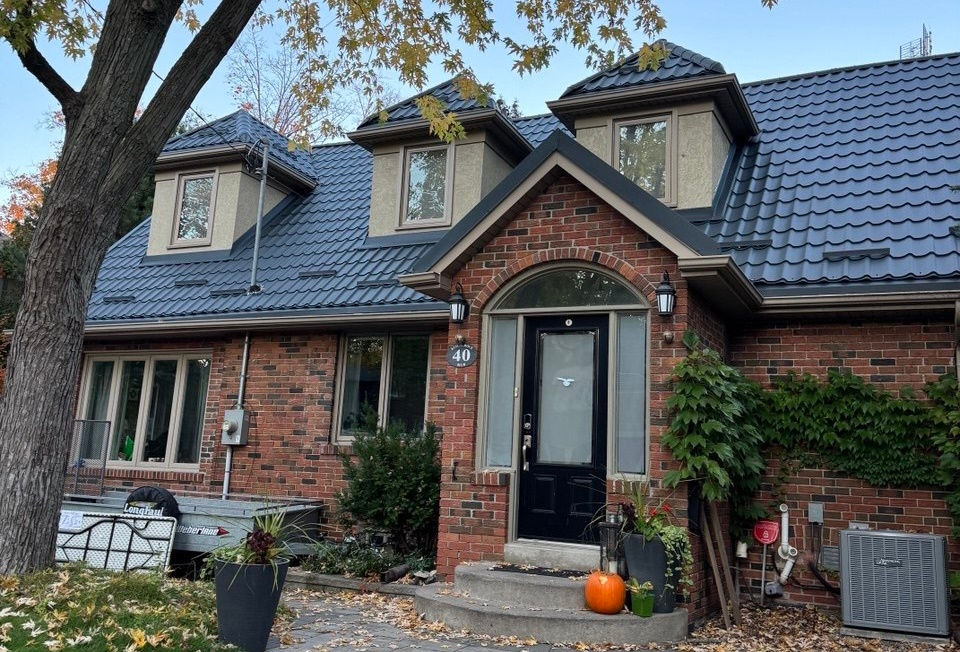
Metal Roofing Materials for Ontario Homes: Matching System Design to the Property
Metal roofing materials can look deceptively simple from the street. A homeowner sees a colour and a profile, but the actual material specification includes the steel substrate, thickness or gauge, galvanizing, primer, finish coating, manufacturing source, panel geometry, and traceability.
For a long-life roof, those details matter because the material is only one part of the final system. MROOF combines material selection with underlayment, ventilation, fastening, flashing, roof geometry, and professional installation so the roof performs as a complete assembly.
Start with the steel substrate
Steel is the structural base of the metal roofing profiles MROOF installs. It provides strength while remaining practical to form into standing seam panels and tile-inspired profiles such as Monterey, Era, Prestige, and Modern.
The important buying question is not simply, "Is it metal?" It is, "What metal, from which manufacturer, with what protective system and documented specification?"
Gauge and thickness are useful, but they are not the whole quality story
Gauge is commonly used to describe steel thickness. Homeowners often focus on this number because it is easy to compare. Thickness is important, but it should not be evaluated in isolation.
A professional material comparison also considers galvanizing, steel quality, profile geometry, panel design, fastening, coating system, and how the product is installed. A thicker panel with poor detailing is not automatically a better roof, just as a premium coating cannot compensate for an unsuitable system design.
G90 galvanizing adds a protective zinc layer
Many MROOF project pages specify G90 galvanized steel. The G90 designation relates to the zinc coating weight applied to the steel, providing a protective barrier that supports corrosion resistance.
The Monterey Metal Tile page and MROOF project documentation both reference G90 steel as part of the material specification. For homeowners, that is useful because it creates a concrete product criterion that can be written into the quote.
The finish coating protects appearance as well as the substrate
The colour visible on a metal roof is part of a multi-layer protective system. Conversion treatments, primers, and finish coatings contribute to adhesion, weathering performance, colour retention, and surface protection.
Coating terminology can vary by manufacturer and product line. A professional proposal should identify the actual material and finish class rather than using a generic colour name as the only specification.
Traceability is one of the strongest material-quality signals
MROOF uses a "trust, but verify" approach. Quality roofing steel should be connected to identifiable manufacturer and production information. Where product markings provide manufacturer, country of origin, production date, batch, or related data, homeowners have a way to verify what arrived on the project.
Read MROOF's ThyssenKrupp material guide for the current explanation of manufacturer markings, German steel sourcing, and material verification.
Profile changes how the material becomes a roofing system
A flat coil of coated steel does not become a roof until it is formed into a profile and integrated with the rest of the assembly. Profile geometry affects appearance, seams, fastening, water shedding, panel layout, trims, and labour.
Monterey Metal Tile provides a classic European tile-inspired appearance.
Era and Prestige offer alternative tile forms for homeowners seeking a different architectural expression.
Modern profiles provide a practical contemporary option.
Standing Seam uses long vertical panels and concealed fastening for a clean architectural finish.
Compare MROOF roofing profiles to see how the same core material can be formed into very different finished systems.
Underlayment and support layers still matter
The roofing steel is the exterior weather surface, but the system below it supports long-term performance. Underlayment or membrane provides an additional protection layer, while roof preparation and support assemblies create the base required by the selected system.
On some MROOF projects, double wood strapping is documented as part of the preparation. On new construction, the system may begin with new plywood and waterproofing membrane. The correct method depends on the property and the chosen roof.
Ventilation protects the complete assembly
Controlled attic airflow is an important building-science component of a long-life roof. Intake and exhaust should be evaluated with insulation, roof geometry, existing vents, and the new roofing system.
The homeowner benefit is not a complicated maintenance routine. It is a professionally designed assembly intended to remain stable with minimal intervention over time.
Project proof: how material specifications appear in real MROOF work
The Kitchener home-and-garage project lists ThyssenKrupp G90 galvanized steel, a black Monterey profile, approximately 1,940 sq. ft. of roof area, double wood strapping, ridge ventilation, and coordinated work across two structures.
The Wasaga Beach new-construction project uses the same material family in a very different application: 3,550 sq. ft. of aluminium-colour Standing Seam with custom flashings and integrated skylights. These two projects show why material and system design have to be considered together.
How to compare metal roofing materials professionally
Manufacturer and origin
Steel gauge or thickness
Galvanizing specification
Primer and finish coating system
Panel profile and seam design
Material traceability or production markings
Underlayment and support assembly
Fastening method
Flashing and trim system
Documented examples of the same material in completed projects
Key takeaways
Metal roofing quality is measurable and should be documented.
Gauge matters, but it is only one part of material performance.
G90 galvanizing and finish coatings provide different layers of protection.
Traceability gives homeowners a way to verify the product.
Profile selection changes both architecture and installation method.
The material must be integrated with underlayment, ventilation, flashing, and professional detailing as a complete system.
Material selection should follow the roof, not the other way around
The strongest material specification begins with the property. Roof slope, panel lengths, valleys, hips, skylights, chimneys, wall intersections, additions, drainage, and visual goals all affect which profile and detailing approach make sense. Selecting a material only because it has an attractive brochure image can reverse the decision process.
MROOF's system approach is to determine how the roof needs to function, then match the profile and material specification to those requirements. That is why the same ThyssenKrupp G90 steel family can appear in a Monterey project in Kitchener and a Standing Seam project in Wasaga Beach while producing two very different roofing systems.
Material documentation supports future ownership
Traceability also has value after installation. A homeowner who has a clear record of manufacturer, profile, colour, material specification, and project details is better positioned when planning later exterior work, additions, solar, or property sale documentation. Long-term value is easier to defend when the roof is documented as a specific system rather than remembered only as "metal."
Frequently asked questions
What metal roofing material does MROOF use on documented projects?
Many MROOF project pages specify ThyssenKrupp G90 galvanized roofing steel, with project documentation identifying profile, colour, roof area, and installation scope.
What does G90 mean in roofing steel?
G90 is a galvanizing designation describing the zinc coating weight applied to steel for corrosion protection. It is one material specification homeowners can compare.
Why does steel gauge or thickness matter?
Thickness is one measurable property of a roofing panel. It should be considered together with steel grade, galvanizing, coating system, profile, span, fastening, and installation design.
What is roofing steel traceability?
Traceability means the material can be connected to identifiable manufacturer, origin, production, batch, or other markings instead of being sold only under a generic label.
Which metal roof profile is best for an Ontario home?
There is no single best profile for every property. Architecture, roof slope, geometry, drainage, substrate, detailing, budget, and aesthetic goals should guide the selection.
Choose a material as part of a complete roof system
Explore MROOF products, review real project specifications, or request a project-specific metal roofing quote.